
- This event has passed.
Harvard Asia Law Conference II

Harvard Asia Law Society (student organization) event:
Harvard Asia Law Conference II
Striving to unite leading professionals, firms, and scholars to discuss the present and future landscapes of law and business in Asia.
Conference Dates: April 1-2, 2026
Location: Harvard Law School (WCC)
Please RSVP to allow us to get a catering headcount!
Conference Agenda:
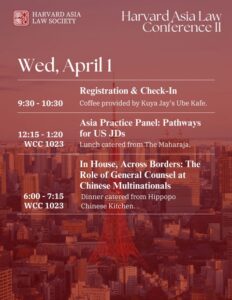
Wed, April 1
Registration & Welcome
–
Grab a conference program and a pastry!
Asia Practice Panel: Pathways for US JDs (WCC 1023)
–
Steven Routh, Partner at Orrick
Jaebok Lee, Associate at White & Case
The Asia Practice Panel highlights the diverse pathways available to U.S.-trained lawyers pursuing Asia-focused legal careers, showcasing transactional, litigation, and regulatory practices. Lunch will be provided!
In House, Across Borders: The Role of General Counsel at Asian MNCs (WCC 1023)
–
This panel brings together senior in-house lawyers from leading Asia-facing companies with major U.S. operations—including TikTok and Temu—to examine the role of in-house counsel at companies operating in drastically different jurisdictions. Speakers will explore how legal teams navigate the complex dynamics between U.S. regulatory environments and the business, operational, and governance priorities of headquarters in China.
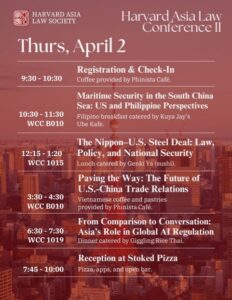
Thurs, April 2
Registration
–
Grab a conference program and a pastry!
Maritime Security in the South China Sea: U.S. and Philippine Perspectives (WCC B010)
–
This panel examines the legal and strategic dimensions of maritime security in the South China Sea, bringing together leading scholars and practitioners to explore one of the world’s most consequential regional disputes from the Filipino and American perspectives. Speakers will discuss the historical background of competing maritime claims, the legal frameworks governing them, and the significance of the Permanent Court of Arbitration ruling involving the Philippines and China.
The Nippon–U.S. Steel Deal: Law, Policy, and National Security (WCC 1015)
–
This panel explores the legal, policy, and economic considerations shaping the U.S. Steel-Nippon Steel merger, drawing on a mix of perspectives from private practice, academia, and policy. The discussion will analyze how legal frameworks intersect with political and economic strategy in evaluating foreign investment. It will also consider the competing policy arguments that shape government decision-making in sensitive cross-border deals.
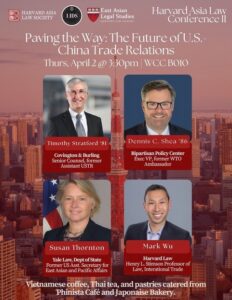
Paving the Way: The Future of U.S.-China Trade Relations (WCC B010)
–
Susan Thornton, Senior Fellow at the Yale Law Paul Tsai China Center; former Acting U.S. Assistant Secretary of State for East Asian and Pacific Affairs (2017-18)
Amb. Dennis Shea ‘86, Executive Vice President and chair of the J. Ronald Terwilliger Center for Housing Policy; former Deputy USTR and U.S. Ambassador to the World Trade Organization (WTO)
Timothy Stratford ‘81, Senior Counsel at Covington; former Assistant U.S. Trade Representative (2005-10)
Professor Mark Wu, Henry L. Stimson Professor of Law and Director of the Fairbank Center for Chinese Studies
The U.S. and China are the world’s two largest economies, constituting nearly half of the global GDP and manufacturing output. They are also each other’s largest trading partners. Yet, over the past decade, their trade relationship has faced steep challenges characterised by an ongoing trade war, intense strategic competition, and geopolitical tensions. Gathering experts on international trade and policy, this panel looks into the history and future of U.S.-China trade relations under the current presidential administration, as well as its implications for law students and the broader Asian legal community interested in practicing in that region.
From Comparison to Conversation: Asia’s Role in Global AI Regulation (WCC 1019)
–
Discussions of AI regulation often revolve around comparisons to a perceived global benchmark, with the EU AI Act positioned as the leading model. This panel shifts the lens. We explore what can be learned from the wide range of AI governance strategies developing across Asia. Governments in the region are experimenting with diverse regulatory tools, institutional structures, and policy priorities that reflect their unique social, economic, and technological contexts. By bringing these approaches into conversation, the panel aims to broaden the global regulatory dialogue and surface insights that may otherwise be overlooked in Eurocentric or single-model comparisons.
Reception – Stoked Pizza
–
Celebrate the close of the Harvard Asia Law Conference II with pizza, apps, and drinks! Mingle with fellow participants in speakers with shared interest in Asian legal practice.