

- This event has passed.
Environmental Public Interest Litigation in China: Cases and Reform
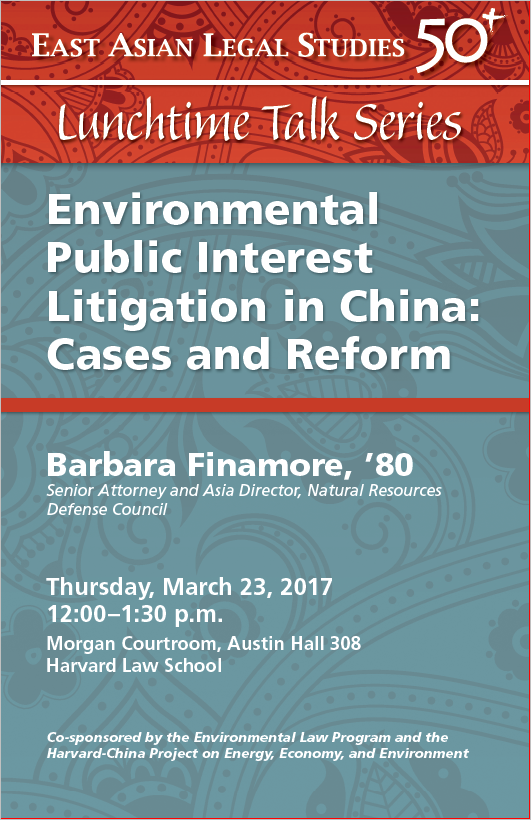

East Asian Legal Studies Lunchtime Talk Series
Barbara Finamore, ’80
Senior Attorney and Asia Director, Natural Resources Defense Council (NRDC)
On January 1, 2015, amendments to China’s Environmental Protection Law went into effect that would allow an estimated 700 Chinese NGOs to bring lawsuits against polluters on behalf of the public interest. The Supreme People’s Court then issued an authoritative “interpretation” that provides clarification and needed details to this new public interest environmental law system. These new rules appear to be designed, in many ways, to make it easier for Chinese NGOs to sue polluters. Yet many challenges still remain. This presentation will provide an overview of the current status of environmental public interest litigation in China, including case studies, challenges and reform efforts.
Sponsored by EALS. Co-sponsored by the Harvard Environmental Law Program and the Harvard-China Project on Energy, Economy, and the Environment.
Ms. Finamore will also lead a Harvard-China Project Research Seminar:
Building Energy Efficiency in China: Policies and Trends
3:30 in Pierce Hall, room 100F, 29 Oxford Street
Energy used in buildings is responsible for 30% of China’s CO2 emissions, a percentage that is expected to grow as China continues to urbanize and transition to a service economy. China has developed a variety of policy tools designed to reduce building energy consumption and waste, including building energy codes, policies and programs to promote the green building sector, and targets and incentives to expand energy efficiency retrofits for existing buildings. This presentation will outline some of China’s key policies and initiatives to improve building energy efficiency, discusses several outstanding challenges and conclude with an overview of latest developments.