
Wu Jingxiong, Between Natural Law and Geopolitics: The Insights and Dilemmas of a Catholic Chinese Law Professor in Cold War America — Jedidiah Kroncke
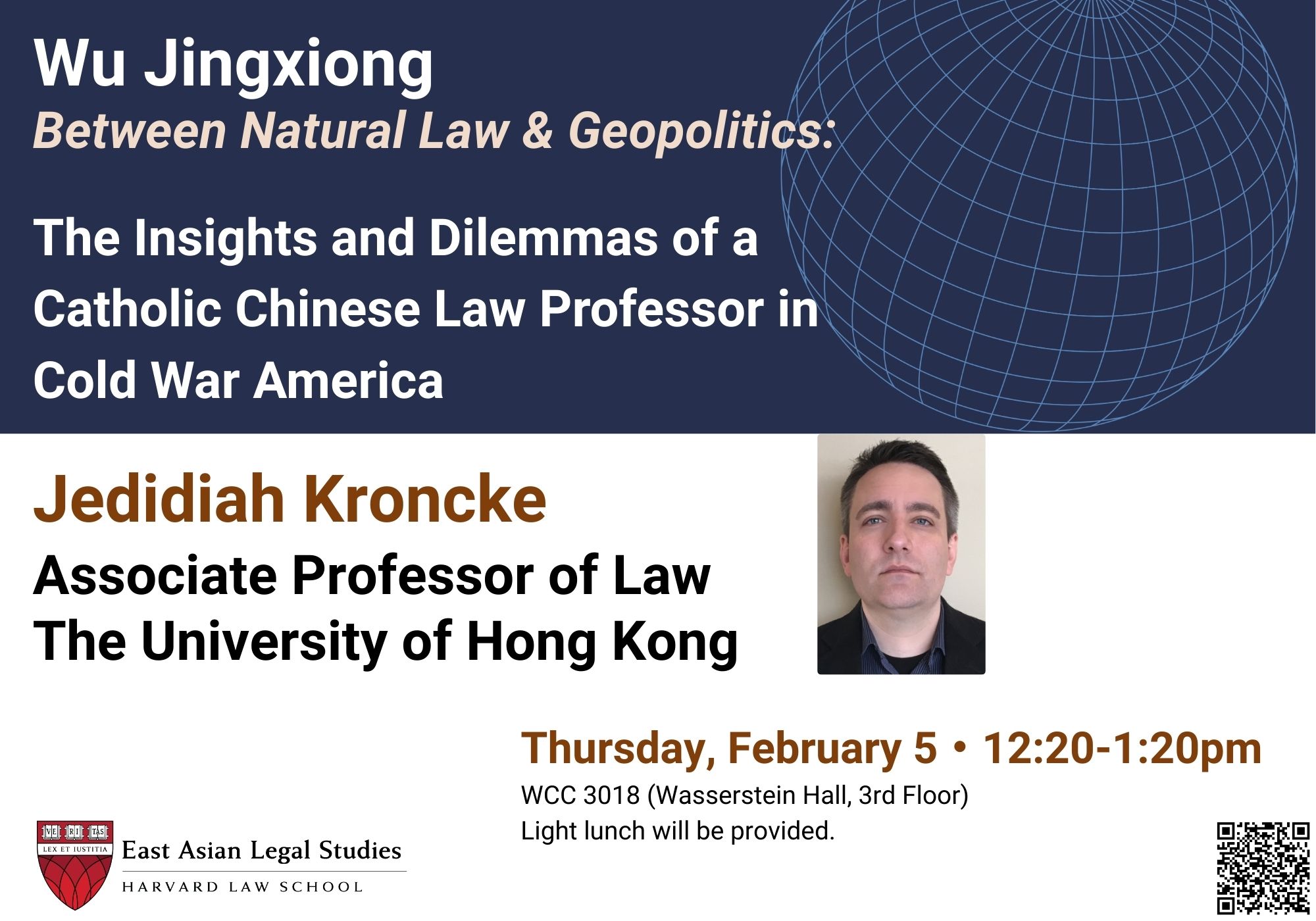
East Asian Legal Studies Talk:
The life of Chinese legal scholar Wu Jingxiong has long attracted attention given his diverse intellectual interests and high profile in Chinese judicial politics and constitutional reform during the 1930s and 1940s. Like many of his generation, Wu’s education combine traditional Confucian schooling with study at multiple Western-influenced institutions. During his first law degree, he converted to Christianity, and his religious journey ultimately led him to become one of the most notable Catholic Chinese intellectuals of this era. Episodes of his transnationalized life have been well-studied—from his relationship with Oliver Wendell Holmes to his engagement with numerous other legal and religious thinkers.
Yet, Wu’s life after the end of the Chinese Civil War in 1949 has received less attention. During this period, Wu spent fifteen years in the United States primarily teaching law at Seton Hall University. While the least studied time of his life, this era was a critical juncture in his ongoing quest to reconcile his Confucian sympathies with his Catholic faith. Wu became a significant contributor to debates regarding the relationship of the common law to natural law and the relationship of Vatican II to Catholic legal thought. he became closely associated with a diverse range of prominent Catholic scholars. Wu’s fondness of Edmund Burke’s ideas led him to develop interlocutors such as Russell Kirk and Peter Stanlis, and led to his frequent citation in post-World War II conservative American legal thought. Simultaneously, he developed a deep friendship with Thomas Merton and others seeking to explore more cosmopolitan visions.
Wu’s ultimate return to Taiwan was impacted by the complications of these debates crosscut by Cold War geopolitical tensions. Wu’s life is revealing not only as an example of the challenges that diasporic Chinese intellectuals faced during this era but also of how his relatively unique intellectual commitments shed light on global tensions in Catholicism and American Cold War geopolitics. Today, amidst rising contemporary Sino-American frictions and renewed debates over the role of Catholic legal thinking in US politics, Wu’s complex American experience as a transnational intellectual is newly provocative and probative.
Dr. Jedidiah Kroncke is an associate professor of law at the University of Hong Kong, where he teaches trust law and the law of cooperative enterprises. His research centers on international legal history and the comparative study of alternative labor and property institutions. His first book, The Futility of Law and Development: China and the Dangers of Exporting American Law (Oxford University Press, 2016), explores the role of US-China relations in the formation of modern American legal internationalism and the decline of American legal comparativism. Other publications have addressed law and development, authoritarian law and legal ethics, the history of international law, and comparative law and political economy. He received a B.A. from the University of California Berkeley, a J.D. from Yale Law School, and a Ph.D. in Social and Cultural Anthropology from UC Berkeley, and then served as a Berger-Howe Legal History Fellow at Harvard Law School, Golieb Fellow in Legal History at NYU Law School, and Ruebhausen Fellow in Law at Yale Law School.
A light lunch will be provided. Please register here.
*Location note: In past years, EALS talks were generally held in Morgan Courtroom (Austin 308), but due to the construction project currently underway next to Austin Hall, we will hold most EALS talks in Wasserstein Hall during the 2025-2026 academic year.