
- This event has passed.
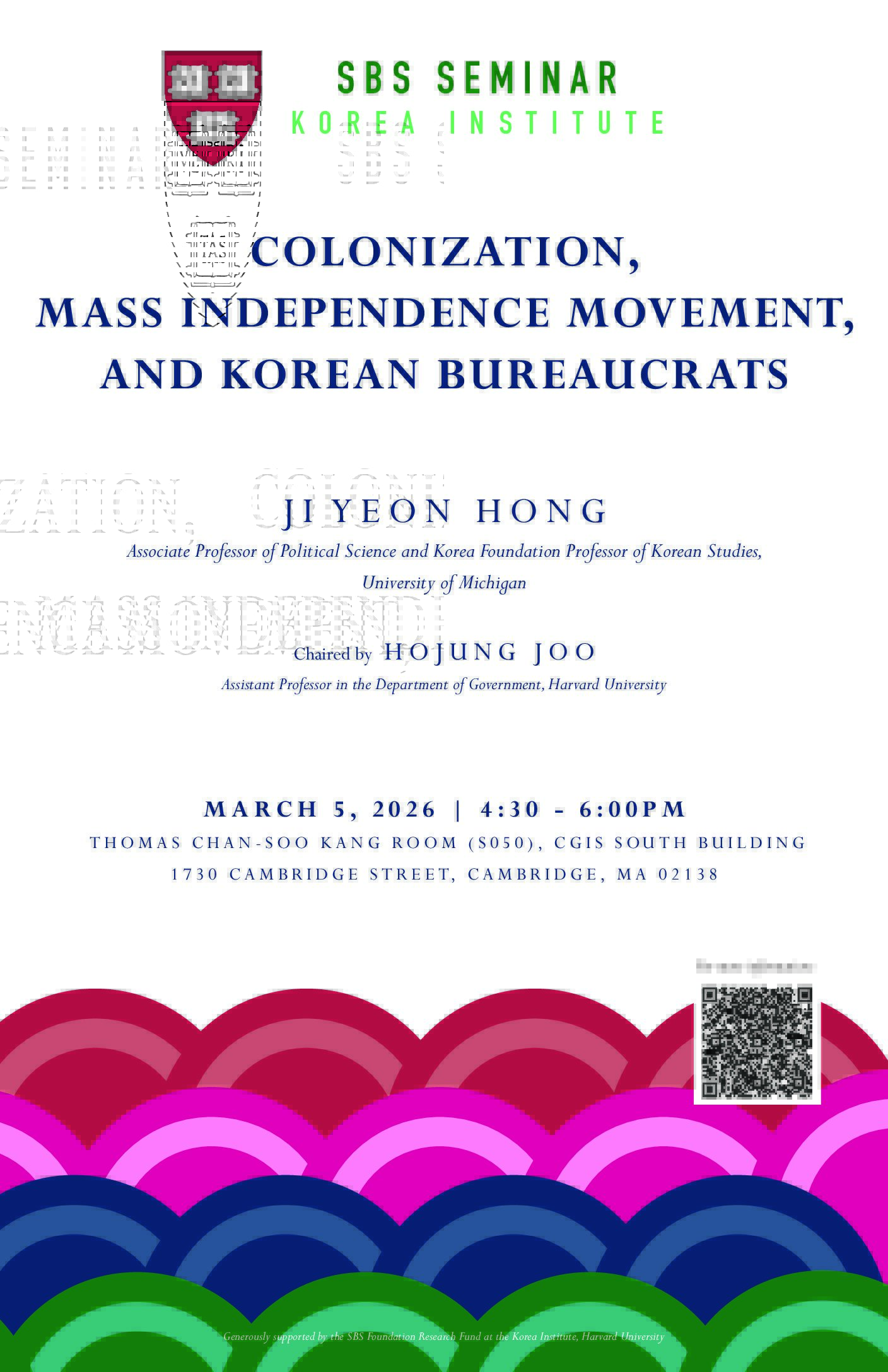
Colonization, Mass Independence Movement, and Korean Bureaucrats

Korea Institute SBS Seminar
Ji Yeon Hong
Associate Professor of Political Science and Korea Foundation Professor of Korean Studies, University of Michigan
Ji Yeon (Jean) Hong is an Associate Professor of Political Science and Korea Foundation Professor of Korean Studies. Her research examines the political economy of authoritarianism, with a focus on East Asia. Her ongoing projects address the legacies of authoritarian rule, the long-term effects of political violence, and the determinants of elite behavior under authoritarian regimes. Her work has appeared in the American Journal of Political Science, British Journal of Political Science, Journal of Economic Behavior and Organization, Journal of Politics, Political Science Research and Methods, and Science Advances, among others. She currently serves as an Associate Editor of Political Science Research and Methods. Prior to joining the University of Michigan, she was on the faculty of the Division of Social Science at the Hong Kong University of Science and Technology. She received her Ph.D. from the Department of Politics at New York University.
Chaired by Hojung Joo, Assistant Professor in the Department of Government, Harvard University
Abstract:
States in transition face acute constraints in building effective governments. A central challenge is recruiting bureaucrats who possess local knowledge while remaining loyal to the ruling authority. This problem is especially salient in colonial settings. This study examines how colonial states managed their bureaucracies and how mass resistance reshaped them. Focusing on Japanese colonial rule in Korea, we collect and analyze data on all bureaucrats employed in the Government General of Korea during 1910 and 1942. We identify officials’ ranks, offices, and work units to evaluate patterns of recruitment, promotion, and unit assignment. We then link these data to detailed records of protest events from the March First Movement of 1919, the largest anti-colonial uprising in Korea. Our analysis shows that the colonial government initially relied heavily on local bureaucrats but steadily reduced its reliance on them over time. The mass independence movement affected the special patterns of expansion. Districts with higher protest intensity experienced significant bureaucratic expansion, particularly in education, yet this expansion did not increase Korean representation in core administrative positions. Korean officials faced persistent barriers to upward mobility, while Japanese officials were disproportionately assigned to strategic sectors to enhance control. These findings demonstrate how colonial rulers managed colonial subjects, particularly in the face of mass resistance, and induced bureaucratic expansion and reorganization without meaningful local empowerment.